EU MDR-IVDR
Determining the Medical Device Classification and related classification rule is the first step in the EU CE Marking process. Technical file and Notified Body application can be made according to the class and rule of the device.
This page gives an overview of the classification approach under the MDR and IVDR. The detailed scope of services for in vitro diagnostic devices is on the IVDR Consulting page, and medical device technical documentation is covered on the CE Technical File (MDR) page.
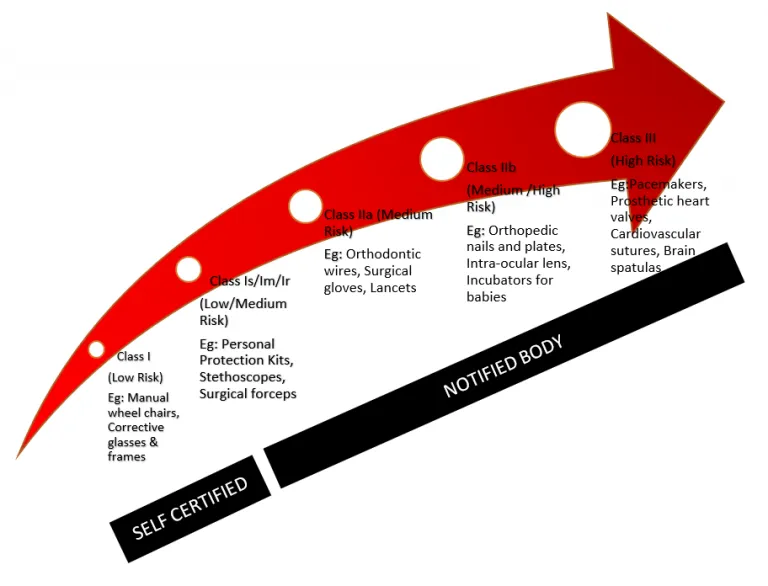
According to Article 51 of EU MDR 2017/745, medical devices are classified as I, IIa, IIb and III, taking into account their intended use and the risks involved. The risk increases from class I to class III. The EU Medical Device Directive (MDD) and the EU Medical Device Regulation (MDR) use a rule-based classification model for medical devices. The new MDR now has 22 rules in Annex VIII.
Class I – Low Risk
Examples: Corrective glasses and frames, Manual wheelchairs
Certification Type: Self-Certification / Declaration
Class Is – Low Risk (Sterile)
Examples: Personal protection kits, Sterile Urine Bags etc.
Certification Type: Notified Body (limited to the aspects of establishing, securing and maintaining sterile conditions)
Class Im – Low Risk (Measuring Function)
Examples: Clinical thermometers with a measuring function, Patient weighing scales
Certification Type: Notified Body (limited to the conformity of the device with the metrological requirements)
Class Ir – Low Risk (Reusable Surgical Instruments)
Examples: Surgical instruments such as forceps, scissors and retractors that are designed to be reused after cleaning, disinfection and sterilisation
Certification Type: Notified Body (limited to the reuse aspects: cleaning, disinfection, sterilisation, maintenance, functional testing and the related instructions for use)
Class IIa – Moderate Risk
Examples: Orthodontic wires, Surgical gloves, Lancets
Certification Type: Notified Body
Class IIb – Moderate and High Risk
Examples: Orthopedic nails and plates, Intraocular lens, Incubators for babies
Certification Type: Notified Body
Class III – High Risk
Examples: Pacemakers, Prosthetic heart valves, Cardiovascular sutures, Brain spatulas, Drug-Device Combination products
Certification Type: Notified Body
The examples are indicative. A device’s class is determined product by product by applying the Annex VIII rules to the intended purpose set by the manufacturer; two devices of the same type can fall into different classes.
Medical Device Classification Rules
In accordance with MDR Annex VIII, the Classification Rules are as follows:
- Rule 1- 4: Non-invasive Devices
- Rule 5 – 8: Invasive Devices
- Rule 9 – 13: Active Devices
- Rule 14 – 22: Special Rules
IVDR Classification
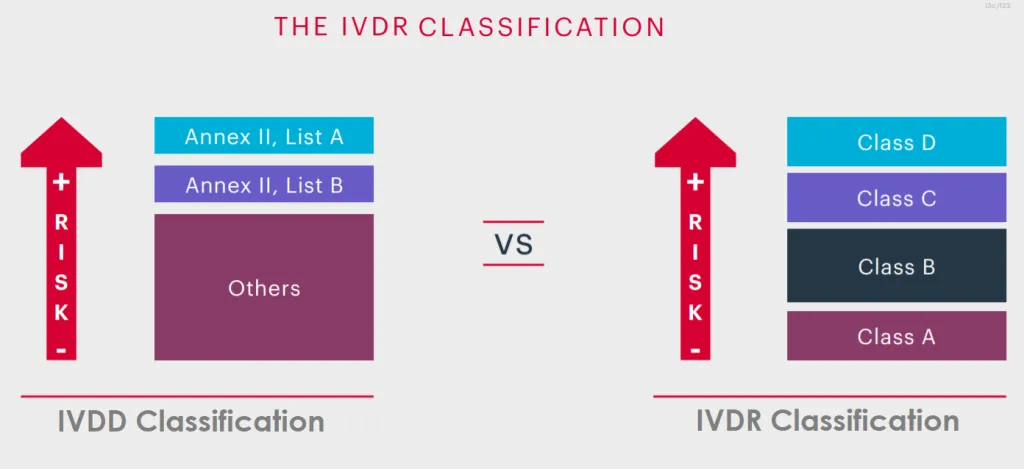
IVDR Classification is based on the intended use and inherent risks of In-Vitro Diagnostic Devices (IVDs), therefore they are classified into classes A, B, C and D, taking into account their intended use and inherent risks.
How are In-Vitro Diagnostic Devices classified in IVDR?
In-Vitro Diagnostic Devices or IVDs are classified in classes A, B, C and D, taking into account their intended purpose and inherent risks. It is classified from the lowest risk category in Class A to the highest risk category in Class D.
Class D (High personal risk, High public health risk)
Examples: Blood grouping ABO, Rhesus (including RHW1), Kell, Kidd and Duffy systems, CHAGAS, Syphilis (used for screening blood donations), Hepatitis B and C etc.
According to the IVDR Classification for Class D IVDs, CE marking can be obtained by conformity assessment methods:
Quality Management System Assurance [Annex IX], then Technical Documentation Evaluation [Annex IX Part II] followed by Verification by the EU Reference Laboratory
OR
Type Examination [Annex X] (includes Technical Documents), followed by Production Quality Assurance [Annex XI], followed by Verification by the EU Reference Laboratory
Class C (High personal risk, Moderate to low public health risk)
Examples: Genetic tests, Companion diagnostics, Blood gas analyzers, Cancer markers, Rubella, Newborn screening for metabolic disorders etc.
According to the IVDR Classification for Class C IVDs, CE marking can be obtained through conformity assessment methods:
Quality Management System Assurance [Annex IX], followed by Evaluation of Technical Documentation per generic device group [Annex IX 4.4-4.8]; for companion diagnostics, also consultation of a medicines competent authority or the EMA [Annex IX 5.2]
OR
Type Examination [Annex X] (includes Technical Documentation), followed by Production Quality Assurance [Annex XI]; for companion diagnostics, also consultation of a medicines competent authority or the EMA [Annex X 3]
Class B (Moderate to low personal risk, Low public health risk)
Examples: Thyroid function tests, Infertility tests, Clinical Chemistry
According to IVDR Classification for Class B IVDs, CE marking can be obtained through conformity assessment.
Quality Management System Assurance [Annex IX] followed by Evaluation of Technical Documentation per category device [Annex IX 4.4-4.8].
Class A (Low personal risk, Low public health risk)
Examples: Instruments specifically intended for IVD procedures, Specimen receptacles, Wash buffers etc.
For non-sterile Class A IVDs, the manufacturer declares conformity by drawing up the technical documentation in Annexes II and III and issuing the EU Declaration of Conformity [Annex IV]; no notified body is involved.
For sterile Class A IVDs, the procedures in Annex IX or Annex XI apply; the notified body’s involvement is limited to the aspects of establishing, securing and maintaining sterile conditions.
Annex III is the technical documentation on post-market surveillance; the EU Declaration of Conformity is set out in Annex IV. Classification is carried out product by product by applying the Annex VIII rules to the device’s intended purpose.